Sarawak
Malaysia, Southeast Asia
旅遊指南
Welcome to Sarawak
Sarawak, on the legendary island of Borneo, offers a travel experience worlds apart from peninsular Malaysia. It's a land of epic scale and intimate moments, where 13-million-year-old rainforests meet the charming, cat-loving capital of Kuching. This is a destination for adventurers, culture seekers, and food lovers, where you can explore the world's largest cave chambers, encounter unique wildlife, savor dishes found nowhere else, and immerse yourself in the rich tapestry of over 40 indigenous ethnic groups.
The Natural Grandeur of Borneo
Borneo, the planet's third largest island after Greenland and New Guinea, is a treasure trove of biodiversity. Its ancient ecosystems are home to over 15,000 plant species and hundreds of mammals, including orangutans and the endemic, long-nosed proboscis monkeys. The verdant landscapes surrounding the Kinabatangan River in eastern Sabah (Borneo's other Malaysian state) are a prime habitat for these primates, with only an estimated 7,000 remaining. Sarawak's adventure reputation is anchored in its geology, famous for thousands of kilometers of cave passageways weaving through limestone cliffs. The crown jewel is Gunung Mulu National Park, a UNESCO World Heritage site with jagged limestone pinnacles, jungle-covered peaks, and vast cave systems. Inside lies the Sarawak Chamber, the largest cave chamber on the planet, so vast it could hold 40 Boeing 747s parked side by side. Nearby is Deer Cave, the world's largest cave passage with a ceiling soaring to 120 meters. At sunset, witness millions of bats streaming out in a swirling ribbon for nearly an hour—one of nature's great spectacles.
Kuching: The Charming 'Cat City'
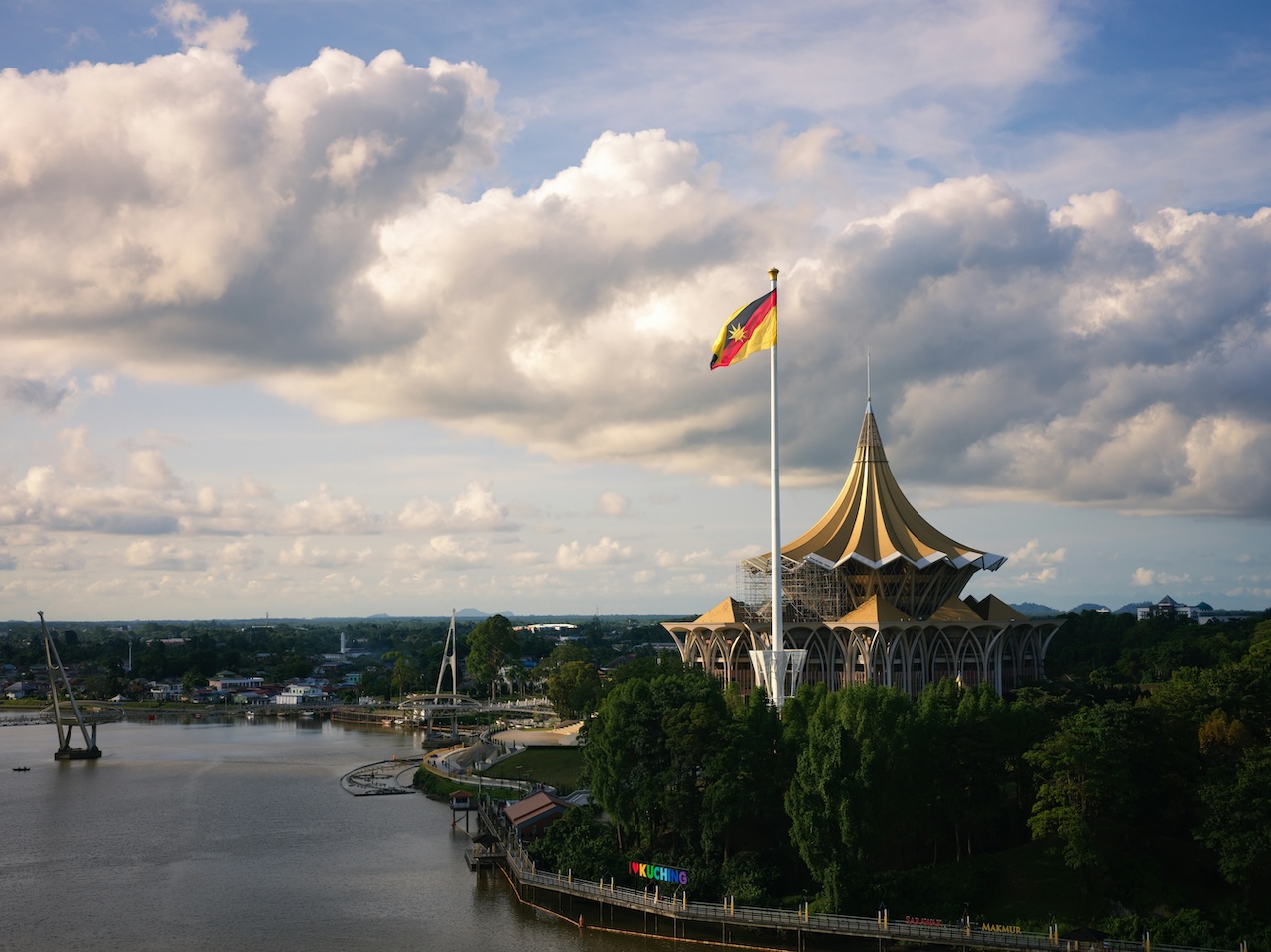
Kuching—'cat' in Malay—is a charming, slow-paced, and warm capital where Chinese and Islamic cultures happily coexist. Its center is a walkable blend of whitewashed colonial buildings from the era of the White Rajahs and traditional shophouses along lanes like Carpenter Street, filled with old temples, eateries, and wall art. The city's lifeblood is the Sarawak River. A stroll across the elegantly curving Darul Hana Bridge (opened in 2017) offers perfect views of the golden-roofed Sarawak State Legislative Assembly Building, a monumental and iconic structure. For the best perspective, a sunset river cruise is a peaceful 1.5-hour journey to watch the water change colour, sometimes accompanied by cultural performances. The city leans into its feline nickname with cat statues on street corners and a full-on Cat Museum. Other key landmarks include Fort Margherita, built in 1870 as a wedding gift, and the historic Masjid Bandar Kuching.
A Culinary Journey in Sarawak
Sarawakian cuisine is a delicious fusion and a highlight of any visit. Start your day with the legendary Sarawak Laksa at spots like Chong Choon Cafe, famous for its spicy, prawn-rich broth. Must-try dishes include Kolo Mee, comforting Quap (rice sheets in a savory broth), and sweet, juicy pork satay. Seek out unique local produce like Midin, a crunchy jungle fern stir-fried with garlic, found only in Sarawak's rainforests. Explore old streets for colourful Kueh Lapis (layer cakes) and local Sarawakian coffee. For a unique highland twist, seek out Barrio Laksa, made with fresh organic ingredients and capsicum.
Cultural Immersion: From Temples to Longhouses
Sarawak is a cultural epicenter, home to over 40 ethnic groups including the Iban, Bidayuh, and Orang Ulu. Many communities still live in traditional longhouses, massive wooden homes built on stilts, sometimes housing up to 100 people under one roof—a way of life built on sharing and community. In Kuching, wander down Carpenter Street and Jalan Main Bazaar, where old Chinese temples sit beside souvenir shops selling tribal costumes, bird's nest, and Sarawak peppercorns. The Tua Pek Kong Temple, said to be the oldest in Kuching, remains one of the most active. For a deep dive, the Borneo Cultures Museum is the largest museum in Malaysia, with exhibits on the state's nature and traditions.
Wildlife Encounters
Sarawak's rainforests are some of the oldest in the world, rich with rare species and biodiversity that rivals the Amazon. At places like Semenggoh Nature Reserve, you can see semi-wild orangutans swinging through the trees as part of a rehabilitation program.
The Kelabit Highlands: Malaysia's Shangri-La
For a truly remote and pristine experience, journey to the Kelabit Highlands and the village of Bario. Inhabited by the Kelabit people, one of Malaysia's smallest ethnic groups, this area is known as the country's Shangri-La—a place of zero crime, no pollution, and a serene highland environment. The region is famous for its Bario rice, the most expensive in Malaysia due to its low yield and manual planting, and incredibly sweet pineapples. A visit here offers profound immersion:
- Longhouse Stay: Experience authentic community living by staying in a longhouse, sharing meals and stories with your hosts.
- Hiking: Trek to the Prayer Mountain for breathtaking views. Trails can be challenging; leech socks, good shoes, gloves, and a guide are recommended.
- Local Culture: Learn about Kelabit traditions, intricate beadwork, and their historical past.
The best time to visit is during the dry season in July for the Bario Food Festival and stargazing, or in January-February to witness the annual rice harvest. Access is via very limited flights on small aircraft, so booking well in advance is essential.
Practical Travel Tips
Getting to Sarawak is easy, with international flights and several local carriers serving Kuching. For getting around, Grab (the ride-hailing app) is widely available. When packing, remember Malaysia is hot and humid; pack light, airy clothes, sunscreen, mosquito repellent, an umbrella, and a universal power adapter (Malaysia uses 220V). For money, it's best to change currency at local money changers in malls for the best rates, and while mobile wallets are common, always carry some cash for street food vendors. Learning a few Malay phrases like 'Apa khabar?' (How are you?) is greatly appreciated. Sarawak reveals itself through its vast natural wonders, storied food, the genuine warmth of its people, and the profound tranquility of its highland retreats.
![[CMCO美食合集] 八打灵Petaling县美食地图,不远游也可以吃得好!](https://cms.nexttrip.my/wp-content/uploads/2020/10/未命名_副本.jpg)


![[ 行动管制令 ] 旅人 飞行前后要准备与注意的事项](https://cms.nexttrip.my/wp-content/uploads/2020/04/飞行前后要准备与注意的事项.jpg)